

Safety and Workers' Compensation Management

Homepage » Communities » Safety and Workers' Compensation Management

News and Analysis

BWC Awards $350,000 in Safety Grants

May 11, 2012

The Ohio Bureau of Workers' Compensation (BWC) has awarded safety intervention grants to 16 Ohio employers totaling more than $350,000.  BWC designed the Safety Intervention Grant Program to help reduce illnesses and injuries and to research and establish best practices for accident and injury prevention.

Ohio employers are eligible for the grants, which include a 2-to-1 matching amount up to a maximum of $40,000 for a total of $60,000: $20,000 from the employer and $40,000 from BWC.  Quarterly data reports and follow-up case studies help BWC determine the effectiveness of employers' safety interventions and establish best practices for other employers.

Hold July 17 for Haz Com 2012 and GHS Webinar

May 04, 2012

OSHA has modified the Hazard Communication Standard (HCS) to adopt the Globally Harmonized System (GHS) to improve safety and health of workers through more effective communications on chemical hazards. 

The GHS is an international approach to hazard communication, providing agreed criteria for classification of chemical hazards, and a standardized approach to label elements and safety data sheets. 

The regulation requirements will be phased in during the next three years, starting with training compliance in 2013.  Here is a one-page summary from OMA Connections Partner, Safex.

OMA has scheduled a 90-minute webinar on Tuesday, July 17 from 10:00 – 11:30 a.m. to help members understand the new standard and compliance obligations.  Pencil it in now; registration will begin later this month.

Bill Would Deny Workers' Comp for Illegal Aliens

May 04, 2012

If Senator Bill Seitz (R-Cincinnati) has his way, illegal aliens would be denied workers’ compensation benefits and could be subject to prosecution for fraud by the Bureau of Workers’ Compensation.  Under SB 323, workers would need to file a new employment disclosure form to certify that they are authorized to work in the U.S.

Senator Seitz testified that the bill will deter illegal aliens from seeking work in Ohio, and that, with Ohio’s 7.5% unemployment rate, jobs should be reserved for U.S. citizens and legal immigrants.  The senator noted that several states have legislated against illegal aliens' receipt of state workers' compensation benefits, including Wyoming, Idaho and Florida.

BWC Extends Deadline for Program Enrollment

May 04, 2012

Earlier this year, the Bureau of Workers’ Compensation (BWC) rolled out a package of new and existing programs called Destination Excellence that is intended to save employers money, improve safety and facilitate injured worker return to work.   Multiple components of the program had an April 30 enrollment deadline.  The BWC has extended the enrollment deadline until May 25 for two of the programs: Industry-Specific Safety Program and Transition Work Bonus Program.

Not all employers are eligible for all programs.  To make it simpler for employers to understand their BWC program eligibility, OMA has created a useful web page.

For more information, contact Georgia Booth, Jay Kemo, or Barb Raduege for details.

MCO Open Enrollment Started This Week

May 04, 2012

Every two years the Ohio Bureau of Workers’ Compensation (BWC) holds a period of open enrollment during which every state fund employer can elect a new Managed Care Organization (MCO).  The 2012 open enrollment period is April 30 to May 25.   The role of the MCO is to provide medical management for employees who have an illness or injury that is covered by BWC workers’ compensation insurance. 

The OMA’s endorsed MCO is Health Management Solutions (HMS).  OMA and HMS are independent entities and have no common ownership; OMA selected HMS based entirely on its quality of service.  The BWC provides an MCO report card to help employers distinguish MCOs’ quality of service; the most heavily weighted metric on report card results is an MCO’s rate of safe, effective return-to-work.  BWC has also created an MCO selection guide for employers.

OMA encourages manufacturers to take this opportunity to switch to HMS.  One important activity HMS performs is aggressively seeking out potentially inappropriate prescription drug costs in employees’ claims and initiating Drug Utilization Reviews from the BWC.  Finding expenses for drugs that are medically unnecessary for the treatment of the allowed conditions in a claim may result in credit adjustments to employers’ experience.

When electing a new MCO, the employer records are automatically transferred from the existing to the new MCO, with no disruption in service.  MCOs are compensated by the BWC through a portion of employers’ premiums. 

BWC Actuary Says Net Zero Base Rate Change in 2012

April 27, 2012

OMA’s Jay Kemo, who attended the Bureau of Workers’ Compensation (BWC) actuarial committee of its board this week, reported that there is expected to be no overall movement in base rates for 2012. 

The BWC’s actuarial firm, Deloitte Consulting LLP, prepared a rate analysis that BWC’s Chief Actuarial Officer, Christopher Carlson, used to develop his 2012 rate recommendations.  In a memo to BWC Administrator, Steve Buehrer, Carlson wrote, “I recommend the BWC establish rates which result in no overall statewide rate change for private employers for the policy year starting July 1, 2012.  I believe this approach will result in an actuarially sound rate level and will meet the requirement to set the lowest possible rates of premium consistent with the maintenance of a solvent state insurance fund.”

While the 500-plus base rates will be calculated individually and while each rate may experience a change, the overall effect is expected to be neutral.  Carlson advises that: “Actual changes at the employer level could vary significantly based upon their actual experience, employee classification, expected loss amounts and participation or not in a group rating plan.”  Actual rates will be formally acted upon by the BWC board in the coming months. 

Further Approved Diagnostic Testing Does Not Justify Continued Temporary Total Benefits

April 27, 2012

OMA Connections Partner, Roetzel & Andress LLP, issued an analysis on an Ohio court case that finds favorably for employers in a workers’ compensation case in which the claimant has reached maximum medical improvement:  In State ex rel. Huffman v. Industrial Commission,  the claimant argued that he was entitled to the extension of temporary total disability (TTD) compensation based upon the authorization by the Industrial Commission of Ohio of diagnostic testing recommended by the claimant’s physicians to further medically treat him for an injury in an allowed claim.  

At the time of this authorization, the Ohio Bureau of Workers’ Compensation (BWC) was requesting that the claimant be declared to have reached maximum medical improvement under the allowed conditions at that time.  The claimant argued that termination of TTD compensation would be premature in light of this authorization, and that he was entitled to continued TTD compensation during the course of this testing.

The Tenth District Court of Appeals disagreed with the claimant’s rationale, citing State ex rel. Jackson Tube Serv., Inc. v. Indus. Comm., where the claimant was entitled to the continued payment of TTD compensation only if the claimant’s allowed conditions had not reached maximum medical improvement.

Per Roetzel, it has been the common practice before the Industrial Commission of Ohio that if any additional medical treatment is authorized the termination of TTD is not indicated.  This case, therefore, is a welcome development, applicable to cases where the claimant has reached maximum medical improvement.

House Cancels Hearings on WC Reforms

April 27, 2012

Introduced last week with a press conference and scheduled for hearings this week, workers' compensation reform legislation was pulled from the committee calendar in the Ohio House.  No official reason was given. 
The measures are opposed by trial lawyers and labor unions.  The bills are supported by Bureau of Workers' Compensation Administrator Steve Buehrer, who provided excellent testimony last week.

The bills, and particularly the main reform measure (HB 517), provide common sense improvements in the medical system that supports injured workers.  The legislation would bring the Ohio system close to the 21st century in its use of modern tools for care management, tools that are used by all health insurance and disability insurance carriers in the U.S., including provider panels and provider outcome measurements.
 
It is a continuing shame to Ohio that the state’s workers’ compensation system remains mired in an outdated and costly medical care management program that so often fails both injured workers and employers.

Read a brief summary of the bills prepared by counsel to OMA, Cavett Kreps of Bricker & Eckler, LLC. 

Open Wound to Hands & Fingers Continue to be Leading Injury

April 27, 2012

Among the OMA’s Workers' Compensation Services customers, open wounds to hands and fingers continue to be the most common injuries that lead to workers’ compensation claims.

In 2011, there were 400 such cases.  In every year tested, this is the leading injury, by number of incidences.

The second and third most prevalent injuries leading to claims in 2011 were: contusion to shoulder, arm, elbow or hand (185 claims) and sprain to lumbar region (97 claims).

The Bureau of Workers’ Compensation (BWC) Division of Safety & Hygiene offers no-charge safety training for all state fund employers, including a few web courses, specifically Preventing Cuts & Lacerations and Avoiding Back Trauma.

While these specific courses may be applicable, the best approach to safety is, of course, systematic.  If you need help establishing or improving your overall safety management practices, do consider the safety consulting services of the BWC, also available at no-charge.

Let us know if you need help accessing any BWC services.  Contact Georgia Booth, Jay Kemo, or Barb Raduege

Long-Awaited Workers’ Comp Reforms Proposed

April 20, 2012

Ohio House Republicans this week introduced a package of three bills (HB 516, HB 517, HB 518) aiming to provide improve the Ohio workers’ compensation system.  The legislation would produce much needed reforms of the medical services provided to injured workers, improving care and cost.

Sponsored by Rep. Barbara Sears (R-Monclova Twp.), HB 517 would require the Bureau of Workers’ Compensation (BWC) to “issue a report grading quality outcomes of medical care organizations (MCOs) and providers within the BWC system—including return-to-work rates—to encourage proper competition between MCOs and providers to ensure that injured workers receive the highest quality care possible. It also obligates the BWC contract with MCOs to create a network of providers that meet quality benchmarks, as well as directions for injured workers to choose a provider focused on return-to-work 45 days following an injury.”

HB 516, also sponsored by Rep. Sears, would “protect injured workers and strengthen the BWC by giving the BWC the authority to decertify providers that present a danger to public health and safety, protect the integrity of BWC fraud investigations by keeping investigation records confidential until the close of an investigation, and require provider decertification appeals to be made in the Franklin County Court of Common Pleas.”

These reforms have been long sought by the OMA.  They are opposed by organized labor and the trial bar.

View the press conference on the bills here

Employer Ordered to Shut Down for Egregious Premium Lapse Violations

April 20, 2012

OMA Connections Partner, Roetzel & Andress, reported that a judge in Cuyahoga County, Ohio recently ordered Gray Container, a 55-gallon drum manufacturer, to discontinue its operations for repeatedly refusing to maintain workers' compensation coverage.  The injunction against Gray Container, requested by the Ohio Bureau of Workers' Compensation (BWC), was filed to protect the company's current employees.  Gray Container has appealed the ruling to the Eighth District Court of Appeals.

Court Sides with Employer on OSHA Recordkeeping Violation Statute of Limitations

April 13, 2012

OMA Connections Partner, Roetzel and Andress LLP, reports that on April 6, 2012, the D.C. Circuit Court of Appeals reversed a longstanding precedent regarding the statute of limitations for violating the Occupational Safety and Health Administration’s (OSHA) recordkeeping requirements.  In AKM LLC v. Secretary of Labor, the court ruled that the statute of limitations for such violations is six months rather than five years.

Per Roetzel: OSHA requires employers to record information about employees’ work-related injuries in three ways.  Employers must (1) prepare an incident report and a separate injury log within seven days of learning that an injury occurred; (2) prepare a year-end summary report, certified by a company executive, of all recordable injuries during the calendar year; and (3) save all of these documents for five years.

The court decided that recording violations are tied to the date of incident, not to the end of the five year retention requirement.

Roetzel attorney Nathan Pangrace blogged, “This decision is a rare piece of good news for the business community in a time where each passing week brings news of increased OSHA enforcement.  The court’s decision reverses a longstanding OSHA precedent and is a significant victory for employers.”

April 30 Enrollment Deadline for BWC Money-Saving Programs

April 13, 2012

There are some programs of the Bureau of Workers’ Compensation (BWC) that might save your company money which have an upcoming April 30 enrollment deadline.

Employers that will not be participating in any BWC alternate rating plans  as of July 1, 2012, (i.e. group experience rating or group retrospective rating) might consider the Drug Free Safety Plan, Industry Specific Safety program, Transitional Work program, and/or Deductible programs

Employers that will be participating in a group experience rating plan as of July 1, 2012, might consider: Drug Free Safety Plan, Industry Specific Safety program, and/or Transitional Work program.

OMA workers’ compensation account managers, Georgia Booth, Jay Kemo, or Barb Raduege can help you further if you have questions.

OSHA Asks Enforcement Agents to Scrutinize Safety Incentive Programs

April 13, 2012

The Occupational Health & Safety Administration (OSHA) released a memorandum to its field compliance officers and whistleblower investigative staff to provide guidance on several employer practices that “can discourage employee reports of injuries,” including safety incentive programs.

Retaliating against a worker for reporting an injury or illness is illegal discrimination.  OSHA indicates it has observed “… that the potential for unlawful discrimination … may increase when management or supervisory bonuses are linked to lower reported injury rates.”

OSHA said that some employers establish programs that unintentionally or intentionally provide employees incentive to not report injuries.  Therefore, OSHA’s guidance to its staff: such safety incentive programs are to be scrutinized as being a potential violation of OSHA’s Section 11(c) in that some incentive programs could constitute unlawful discrimination/retaliatory action against workers who do report injuries.  In addition, the programs also are viewed as potentially constituting an “employer’s failure to report injuries” and thus a violation of the recordkeeping standard as well.

OMA Connections Partner, Calfee, prepared this alert on the matter. 

Ohio High Court Clarifies Unemployment Benefits Not Used to Calculate Workers’ Comp Awards

April 06, 2012

Regarding State ex rel. Warner v. Indus. Comm., OMA counsel, Cavett Kreps, of Bricker & Eckler LLP, explains: “The Ohio Supreme Court clarified average weekly wage (AWW) calculations when an injured worker had a period of unemployment during the year preceding a work injury.  Typically, the AWW is calculated by dividing the total wages for the year prior to the injury by 52 weeks.  But an exception to this rule excludes the weeks that correspond with "any period of unemployment due to sickness, industrial depression, strike, lockout, or other cause beyond the employee's control." 

Per Kreps: “The court explained that a period of seasonal unemployment may be subtracted from the 52 week standard if the injured worker demonstrates that the weeks of unemployment were beyond the injured worker's control.  Although receipt of unemployment benefits is contingent on demonstrating some efforts to seek employment, the court found that an injured worker must independently convince the Industrial Commission that the injured worker's unemployment was beyond the injured worker's control. The court also explained that the amount of unemployment benefits received is not included in the total wages calculation when calculating the AWW. “

Employers with seasonal employees will want to note this case. 

OSHA Modifies the Hazard Communication Standard to Adopt the GHS

March 23, 2012

The Occupational Health and Safety Administration (OSHA) has modified the Hazard Communication Standard (HCS) to adopt the Globally Harmonized System (GHS).  This change is intended to improve worker safety and health through more effective chemical hazard communications.

According to, Dianne Grote Adams, president of OMA Connections Partner, Safex, “The Globally Harmonized System (GHS) is an international approach to hazard communication, providing agreed criteria for classification of chemical hazards, and a standardized approach to label elements and safety data sheets.  The regulation requirements are planned to be phased in during the next three years.”

Employers will need to train employees on the new label elements and safety data sheets by December 1, 2013, with compliance milestones in 2015 and full compliance by 2016.

According to OSHA: “During the transition period to the effective completion dates noted in the standard, chemical manufacturers, importers, distributors and employers may comply with either 29 Code of Federal Regulations 1910.1200 (the final standard), the current standard or both.”

The 850+ page rule can be found here

2012 Ohio Safety Congress & Expo Coming March 27-29

March 02, 2012

The Ohio Safety Congress & Expo is the largest and longest-running occupational safety, health and workers’ compensation event in the Midwest.  The event is free and offers high quality keynote speakers, extensive educational sessions, and the Expo Marketplace features occupational safety products, services and innovations.  This year’s event is March 27 to 29 at the Greater Columbus Convention Center. 

BWC Administrator Buehrer Testifies on Progress and Goals

March 02, 2012

Administrator Steve Buehrer of the Ohio Bureau of Workers’ Compensation (BWC) updated a House committee this week on new programs developed by the BWC over the past year.  Among those described by the administrator were the Grow Ohio program (for new businesses), an expanded safety council discount program (for companies that join local safety councils), and a wellness grant program (providing up to $15,000 for company wellness programs).  He also noted expanded anti-fraud activity, a focus on prescription drug abuse and cuts in administrative costs.

Administrator Buehrer said:  “While these are significant steps in the right direction, further reform is needed to address some troubling trends.  Despite Ohio trends that show the number of workers' compensation claims falling and with it the overall medical spend, claim costs are rising precipitously, with the average medical and indemnity cost per claim rising at a much faster rate than other states across the country.”

The administrator told the committee that “my immediate goal is to focus on return to work and achieving the best possible outcomes for our injured workers.  In these efforts we are currently focusing on areas to improve outcomes such as triaging claims, medical management, vocational rehabilitation and settlements".

OSHA Hazard Communication Standard Changes Probable

March 02, 2012

The White House Office of Budget Management has reportedly completed its review of OSHA's final rule to align its hazard communication standard with the United Nation’s Globally Harmonized System (GHS).

If enacted, the rule would change the criteria by which companies classify hazards, compile safety data sheets, and train their workers on hazardous chemicals.

OSHA is expected to publish its final rule in the Federal Register.  If and when enacted, OMA will have learning opportunities for members on the new rule.  3/01/2012

Offer Light Duty Work to Defend Temporary Total Claims

February 24, 2012

According to an analysis of the Ohio Supreme Court case, State ex rel. Akron Paint & Varnish, Inc. v. Gullotta, OMA Connections Partner, Roetzel & Andress indicates that offering light duty work can be both a cost reducer in a claim and an effective defense to the payment of temporary total compensation.

If a claimant refuses to accept work that is within the physical capabilities provided by the claimant's attending physician, temporary total compensation is not payable. This legal principle was reinforced in this case. 

OMA members using OMA Workers’ Compensation Services can learn more about how to effectively make an offer of light duty, which needs to be detailed in writing, and consistent with the medical restrictions of the attending physician, by contacting their account manager, Georgia Booth, Jay Kemo or Barb Raduege

BWC Officials Visit Manufacturers

February 24, 2012

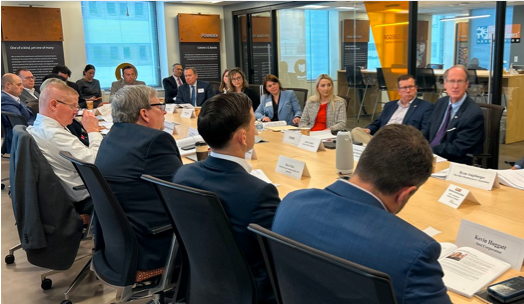
BWC Chief of Employer Services Kevin Abrams and BWC General Counsel Jason Rafeld visited the OMA Safety and Workers’ Compensation Committee this week.  Abrams discussed return-to-work cost trends and highlighted new employer discount programs

Rafeld described new more aggressive claim settlement procedures that went into effect in January. 

Join the OMA workers' compensation management community; here are the meeting materials. 

BWC Accepts Wellness Grant Applications

February 17, 2012

The Ohio Bureau of Workers' Compensation (BWC) is accepting applications for its new Workplace Wellness Grant Program, created to help employers improve the overall health of their workforces, which the BWC asserts will reduce workplace injuries and illnesses.

Participating employers receive up to $15,000 over four years to implement wellness programs that address, among other risk factors, obesity and chronic disease. The BWC intends to measure the effectiveness of the program in reducing claims frequency and costs, improving return-to-work rates and reducing employer health care costs.

OMA Connections Partner, Roetzel & Andress, provides this guidance to employers who might consider participating.

Applications for the BWC wellness grant program are available at www.ohiobwc.com.  Employers are encouraged to call 1-800-OHIOBWC to verify eligibility before submitting an application.

OMA Group Rating Deadline; BWC Program Compatibility Changes

February 17, 2012

Employers who plan to enroll in the OMA workers’ compensation group rating program are reminded that today is the deadline to enroll, and anyone not yet enrolled should contact us so we know to hold your spot.

Employers planning to participate in the OMA group retrospective rating program have until April to enroll.  Please contact Denny Davis with your questions.

According to program compatibility changes enacted by the Bureau of Workers’ Compensation (BWC), beginning July 1, 2012, employers can no longer participate in any form of deductible program if they also participate in group experience rating.

BWC program compatibility can be confusing; contact your OMA account manager, Georgia Booth, Jay Kemo or Barb Raduege with your questions. 

Recent Ohio Appellate Decision Allows Employer’s Post Claim Certification Dispute

February 03, 2012

OMA Connections Partner, Roetzel & Andress, reports a mechanism exists for Ohio self-insured employers to dispute a claim post-certification where certain grounds exist.  A Roetzel blog post does a good job of describing the implications to employers of the recent Ohio appellate decision, Lane v. Bur. of Workers’ Comp, which establishes the grounds for “continuing jurisdiction.” 

BWC Introduces Pharmacy Provisions Intended to Limit Abuse

February 03, 2012

The Bureau of Workers’ Compensation (BWC) announced the introduction of a program that allows it, under certain circumstances, to restrict an injured worker to the use of a single pharmacy for non-emergent prescriptions.  The injured worker selects the pharmacy from a list of eligible pharmacies.  BWC can also restrict an injured worker convicted of a drug offense to the use of a single prescribing physician, selected by the injured worker from BWC certified physicians, in order to receive reimbursement for non-emergent prescriptions.

The BWC has established a Pharmacy and Therapeutics Committee comprised of practicing pharmacists and physicians to advise BWC leadership on issues related to the use of medications prescribed to treat injured workers. 

Long observed by OMA’s team of workers’ compensation account managers as a cost issue for employers, the committee is reported to be conducting "relatedness editing" to ensure injured workers are receiving medications relevant to their conditions. 

New OSHA Videos Provide Training on Proper Use of Respirators

February 03, 2012

The Occupational Safety and Health Administration (OSHA) has posted a series of 17 videos, in English and Spanish, to help workers learn about the proper use of respirators on the job.

Topics include OSHA's respiratory standard, respirator use, training, fit-testing and detecting counterfeit respirators, and are available with closed captioning for streaming or download. 

Class Action Suit Proceeds Against Ohio BWC for Alleged Overcharging of Nongroup-rated Employers

February 03, 2012

Employment Services Alert - January 2012:  A class action lawsuit currently pending in the Cuyahoga County Court of Common Pleas alleges that the Ohio Bureau of Workers' Compensation (BWC) charged excessive workers' compensation premium rates to employers who were not able to participate in Ohio's group rating program. See San Allen, Inc., et al. vs. Stephen Buehrer, Administrator of the Ohio BWC, Case No. CV-07-644950.  From OMA Connections Partner, Roetzel & Andress.

BWC Publishes Report on Program Participation Trends

January 27, 2012

The Bureau of Workers’ Compensation (BWC) shared this report of its program participation trends during its monthly board of directors meeting this week.  The report shows employer participation trends in the BWC’s group rating, group retrospective rating, deductible, experience modifier (EM) capped, one claim and paid loss retrospective rating programs over the policy years 2009 through 2011.

Some observations: $1,000 is the most popular deductible level selected by employers participating in the program; group retrospective rating is gaining in employer participation since its introduction in 2009 and the initial participants shared in premium rebates; significantly fewer employers are leaving one group rating sponsor for another as 27,000 switched sponsors in policy year 2010 as compared to 10,000 in policy year 2011.

As a workers' compensation third-party administrator, the OMA manages all of these programs on behalf of its members, focusing exclusively on manufacturers’ requirements.  If you have questions about which BWC programs are right for your company, contact Georgia Booth, Dennis Davis, Jay Kemo or Barb Raduege.  OMA has created analyses for most BWC programs that can be run specifically for your company to show you how to maximize savings and minimize risk.

BWC Says Employers Who Paid Premium Electronically Won’t Get Paper Payroll Report

January 20, 2012

If you’ve paid premium electronically one or more times in the past couple years, the Bureau of Workers’ Compensation indicates that it intends to send you a post card reminder but not a hard copy payroll report.

Whether or not you receive a post card reminder, premiums for the second half of 2011 are due February 29, 2012.

The BWC encourages all employers to file their payroll reports electronically to save resources.  Questions can be directed to (800) OHIOBWC.